Beautiful Native Plants


Blog HOME ***Our team of bloggers writes about all aspects of ecosystem gardening, from native plants to pollinators and wildlife.***
Showing posts with label insects. Show all posts

Thursday, February 20, 2020

Insects are a Weighty Matter

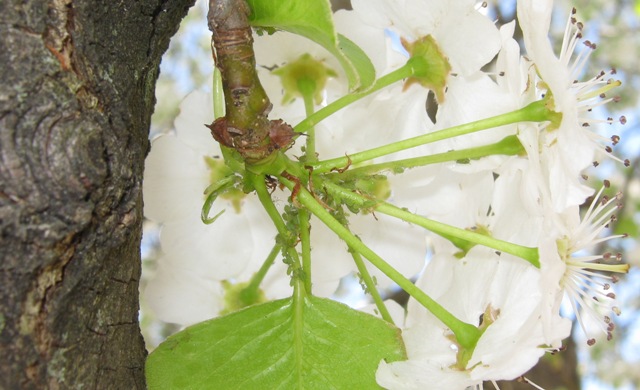
Aphids on a pear tree
One of many out-of-sight colonies,
amounting to several pounds of insects per tree
© Beatriz Moisset
If all the insects in an acre of land chose to sit on you, they would crush you. Is that possible? How many insects are there in an acre and how much do they weigh?

To get a better perspective on the importance of insects, I set myself the task of finding out how many insects there are in any ordinary garden or field. An entomologist/gardener, Frank E. Lutz did just that more than 70 years ago.

Monday, March 13, 2017

Bumble Bees: Panda Bears of the Insect World


The impatient bumble bee (Bombus impatiens)
the most common bumble bee in the Eastern US
© Beatriz Moisset

Most people hate or fear insects with just a few exceptions. Bumble bees have enough charisma to be loved, at least by children. You find children’s books, toys, and Halloween costumes about bumble bees. Perhaps what makes them acceptable is their fuzzy roundish appearance reminiscent of a tiny bear. This positive image is reinforced by their cheerful buzzing sound and their penchant to visit flowers. This is one insect whichpeople find easy to accept in a wildlife garden.

Saturday, February 25, 2017

Viburnum Under Siege. Part Two

Editor’s note: this is part two of this series. Don’t miss part one of Viburnum Under Siege.

The accidentally introduced pest, viburnum leaf beetle (Pyrrhalta viburni) or VLB for short, can destroy a shrub in just a couple of years. Unfortunately it continues to spread through North America. So I am trying to learn more about it, hoping that we can protect the viburnums in our area. This is the information that I have gathered from the sites listed and from my own observations. It doesn’t look very encouraging.

VLB larvae and leaf damage
© Beatriz Moisset
The grubs or larvae emerge from eggs early in the spring. They are yellowish or greenish, with black markings and can reach one third or a quarter of an inch in length.
They spend a few weeks feeding on the leaves by making numerous little holes between the veins. These holes are easy to identify. By early or mid June they climb down along the stems and bury themselves in the ground to pupate. When I searched for them in mid June, I found none, only the damage remained.

Tuesday, February 21, 2017

Viburnum Under Siege

Leaf damage inflicted on arrowwood
by the viburnum leaf beetle
© Beatriz Moisset
 The shoots of Viburnum dentatum are thin, strong and straight. Native Americans used them for arrow shafts. That is why this shrub is often called arrowwood. Until recently it was considered as a plant free from serious pests. Now, the arrowwoods in my area are under attack by an invasive leaf beetle.

Last May (2010), I began noticing leaves full of holes (skeletonized); something that I have never seen before. I finally spotted the culprits, little bugs hiding on the underside of damaged leaves. They look somewhat like caterpillars, but not quite; they are greenish, with black dots. A visit to the Bugguide site helped me identify them and provided links to several university sites full of information (see below). They are the larvae of the viburnum leaf beetle (VLB for short, Pyrrhalta viburni), an introduced pest from The Old World. Both the larvae and adults of this beetle feed exclusively on a variety of species of viburnum.

Viburnum leaf beetle larva and leaf damage
© Beatriz Moisset

Wednesday, February 8, 2017

Winter Food for Birds

Field of Canada goldenrod. © Beatriz Moisset
 When the days get shorter and other signs of winter hang in the air, most birds pack their bags and leave for warmer climates. They are not necessarily running away from the cold weather, but from the lack of their favorite food, insects.

Not all leave; the ones that can make it through the winter on nuts and berries stay. Also those who know where to find insects stay. Woodpeckers belong to this latter category. Some, such as hawks and owls, who feed on other birds, mice and other small creatures, also stay.

Monday, February 6, 2017

Biocontrols. Fighting Fire with Fire

Mile-a-minute choking trees
© Beatriz Moisset
 What to do when an introduced species, be it a plant or insect, gets so out of control that eradication seems impossible? This is a serious consideration. We see it happens again and again. Many species are so entrenched that all efforts seem futile, from the most ecologically benign, such as physically removing the offenders, to the least desirable ones, the use of pesticides.

Part of the reason why some introduced organisms become invasive is that they left behind the enemies that kept them in check in their native lands. Once free from such restraints they can become enormously successful in their adoptive land. When other methods of control fail conservationists have been resorting to what I would call fighting fire with fire: bringing another introduced species to control the one that has become a pest. These are the so called biological controls or biocontrols. This method is a partial admission of defeat. It allows the invasive species to remain but minimizes its impact. The National Wildlife Federation says it best:
In vast natural areas such as the Everglades, where spraying, snipping or bulldozing exotic weeds is out of the question, a well-tested, well-behaved bug is the conservationist’s best weed whacker.

Thursday, August 11, 2016

In Praise of Wasps

Southern Yellowjacket (Vespula squamosa)
© 2007 Beatriz Moisset
Most people I talk to express an inordinate hatred for wasps. They agree that bees are important because they are pollinators, but think that wasps play no role in nature other than mistreat us with their stings. It is time that somebody comes to their defense. I will do more than that; I will sing their virtues.

Friday, July 1, 2016

From lawn to woods: a retrospective

Spring 2014: a pinxter azalea in the front meadow.

Then and now…


I posted the above photo of my pinxter azalea (Rhododendron canescens) a while back with the comment that with the exception of the trees next to the pond (behind the top sprout on the right), this area used to be lawn. People were really surprised and asked for more details and more information about how it was transformed, so I thought I’d share the history here. (Update: I also used this photo on the cover of my book, The Art of Maintaining a Florida Native Landscape.)

Wednesday, June 29, 2016

Ferns in the landscape

Ferns create a soft edge between a wooded area and a lawn. Here you see a mixture of netted chain ferns and cinnamon ferns along with magnolia, St. Johnswort, sweet gum, and more.

Ferns are Living Fossils

Ferns belong to the Pteridophyta Division of the plant kingdom in that they have leaves, roots and stems, but since they spread by spores, ferns do not have flowers, pollen, fruits, or seeds. Today's ferns descended from ancient plants that covered the earth long before the seed plants (the gymnosperms and angiosperms) made their appearance.

Monday, June 27, 2016

Florida’s roadside meadow program

A Florida roadside meadow on 5/1/14 really “pops” and the adjacent farm is planted with wildflowers, too.
I took the long way home from a meeting with my editor at University Press of Florida in Gainesville and Marjorie Shropshire, my illustrator, last year. Marjorie and I stopped to photograph this amazing meadow in Putnam County. (Located in the south central section of district 2 as shown in the map below.)

Chicago’s Lurie Garden: a very public native space

I was in Chicago last month. This self-portrait
was looking into the heavily
 finger-printed reflective bean sculpture.

My husband and I visited Chicago’s Millennium Park a while back and were in full tourist mode taking photos of the reflective bean sculpture, the interesting fountain that spits water at you, the big heads and other famous attractions there. What a pleasant surprise to find Lurie Garden in the center of this very popular space. Designed by Gustafson Guthrie Nichol Ltd, Piet Oudolf, and Robert Israel, this 5-acre garden provides a sustainable and mostly native plant collection.

Helping to redefine what a beautiful garden should look like

Lurie Garden is in a very public area. How wonderful that it’s planted mostly with natives.
We were there early on a Sunday morning to avoid the crowds. We spent a lot of time walking around the garden. What a wonderful example to help redefine what a real garden is supposed to look like. In a way this is a follow-up to my last post on New York’s High Line Park. (Piet Oudolf was also the planting designer for the High Line Park, so there are many similarities.)

Sunday, June 26, 2016

6 easy ways to save time & money in your landscape

As we approach each new year, many people will make resolutions that will probably not be kept for long, but changing to a more sustainable landscape regimen is one resolution that is easy to keep. While you are saving time and money, you’ll also be supporting a variety of wildlife.

Having more birds and butterflies in your yard is priceless!

Here’s a short list of money-saving landscaping resolutions: 

Let the predators in your landscape do the heavy lifting.
A potter wasp found a caterpillar to take back to its nest.
In ecosystem gardening, you cheer for the predators
and would never poison them.

1) Stop the landscape-wide poisons

You can save a lot of money and time when you stop trying to poison pests in your yard. After an adjustment period, the natural predators will get to work on those pests. As a bonus when you stop all landscape-wide pesticides, you’ll be creating a wildlife-friendly landscape that will be filled with butterflies and birds. (See #2 for poison-free lawns.)

See my post, A poison is a poison is a poison, for more details on the poison cycle and how to jump off.

Saturday, June 25, 2016

A poison is a poison is a poison

A working ecosystem means that 
you encourage Mother Nature's predators. 
Here, a garden spider captures
 a polka-dotted wasp moth.

The Poison Cycle

In a balanced ecosystem, predators will be in the minority. In other words, in a natural environment, there are many more prey organisms to ensure a continuous food supply for the predators. In such an ecosystem, there are huge numbers of prey including, aphids, white flies, cabbage worms, leaf miners, mole crickets, spider mites, and others that may be eating your crops, lawns, and landscape plants, but relatively few predator bugs such as praying mantids, assassin bugs and relatively few bug predators such as lizards, toads, birds, and bats.

Let's consider what happens when you attempt to poison pests. A general insecticide (organic or not) will kill the majority of bugs in an area, but more than 90 percent of them were beneficial or benign. Predators such as bats, frogs, lizards, and birds will go elsewhere to feed and even the microbes in your soil may die.

Wednesday, May 18, 2016

The Science Behind our Commitment to Native Plants

Luna moth (© B. Moisset)
Don’t you get tired when you hear words like: “nativistic mania”, “simplistic assumptions”, “nostalgic”, and “sentimental notions”? Not to mention the stronger ones: “native-plant fundamentalist”, “xenophobia”, “native plant Nazi”?

Friday, February 26, 2016

Praying Mantises. Which are the Good Ones?

Chinese mantis,  Tenodera sinensis, preying on a hummingbird
© JeanneScott-Zumwalt
Mantises, along with lady beetles or ladybugs are beloved insects, considered good pest controls worth having in the garden. Mantises, or mantids, are charismatic because of their remarkable looks and large size. Some value them as pets or use them in school projects. The females have the bad reputation of devouring their mate’s heads, although this is probably largely exaggerated and not as common in the wild as it is with caged ones. They invented Styrofoam to build their egg cases long before humans did, more on this below. Just as there are many species of lady beetles, there are also many different mantises. The good news is that while lady beetle species number in the hundreds, there are only twenty kinds of mantises. The bad news is that four or five of those species are not-native and may be causing problems for the native ones.

Monday, February 22, 2016

Teeming with zebras

The zebra longwing butterfly (Heliconius charithonia
drinks at the snow squarestem.

Zebra longwing butterflies that is...

This year we’ve had a huge jump in population, so our property is aflutter with all their striped glory. They don’t have deep wing beats like a lot of floppy butterflies–their wings hardly move as they fly. They are skittish compared to some other butterflies, but they are mesmerizing.

Ladybugs, Lady Beetles or Ladybird Beetles. How Good are They?

Polished lady beetle. © Beatriz Moisset. 2012
 What is in a name? Most call it a ladybug; others, ladybird or ladybird beetle or just lady beetle. Is one name more appropriate than others? Is there just one kind, or many kinds of this insect? Scientists prefer the term Coccinellidae to include all the members of this large family of beetles. The technical name has the advantage of leaving no room for confusion.
Seven-spotted Lady Beetle (Coccinella septempunctata). © Beatriz Moisset. 2013
 Ladybug is not entirely correct because “bugs” are insects with sucking mouth parts and simple development. “Ladybugs” are, in fact, beetles, with chewing mouth parts and with a full metamorphosis, with larva, pupa and adult, similar to that of butterflies. So the preferred common name is lady beetle.